


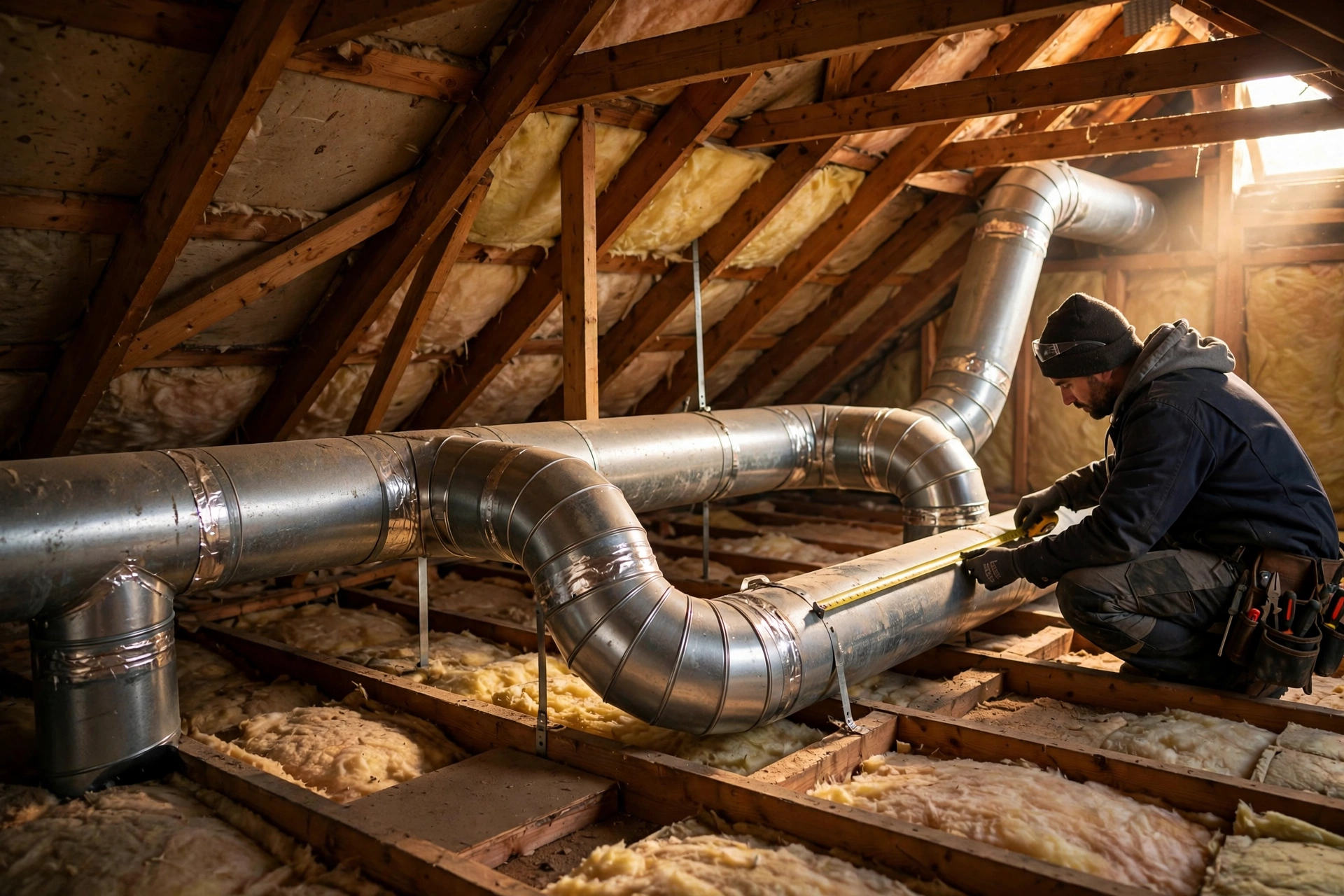

How far can your dryer vent run? Further than you’d think — but not as far as many Texas homes actually run it. The building code sets a hard ceiling on maximum dryer vent length, and exceeding it means lint-choked ducts, marathon dry times, and real fire risk. Here’s how the IRC dryer vent length rules work and how to check your own home.
The 35-Foot Rule
IRC Section M1502 caps the developed length of a dryer exhaust duct at 35 feet, measured from the dryer’s outlet to the exterior termination. “Developed length” means the actual path the air travels — including every bend — not the straight-line distance through the house.
Why 35 feet? Beyond that, even a clean duct can’t reliably carry lint and moisture out. Airflow drops, lint settles, and the system slowly strangles itself.
Deductions for 45° and 90° Bends
Bends are worse than straight pipe — each one adds turbulence where lint drops out of the airstream. The IRC accounts for this by deducting equivalent length per fitting:
- Each 90° elbow: deduct 5 feet from the 35-foot allowance.
- Each 45° elbow: deduct 2.5 feet.
So a run with three 90° elbows has an effective maximum straight length of just 20 feet (35 − 15). Two-story Texas homes with laundry rooms upstairs and roof terminations burn through this budget fast — see our roof vent guide for Houston.
The Manufacturer-Instructions Exception
There’s one important caveat: if your dryer’s manufacturer specifies a longer permitted exhaust length (many modern dryers allow it, with tables by duct diameter), the manufacturer’s instructions govern — code explicitly defers to them. Check your dryer manual’s venting table; it’s the final word for your specific machine.
Worked Example: Is Your Vent Too Long?
Take a typical Texas two-story layout: dryer on the second floor, duct runs 12 feet horizontally, two 90° elbows to turn vertical, then 14 feet up through the attic to a roof cap.
- Straight duct: 12 + 14 = 26 feet
- Elbows: 2 × 90° = 10 feet equivalent
- Developed length: 36 feet — over the 35-foot limit
This extremely common layout is technically non-compliant without mitigation — which is where booster fans come in.
Booster Fans: When and How
A dryer booster fan is an inline fan that assists airflow on long runs. Rules of thumb:
- Consider one when developed length exceeds the code/manufacturer limit.
- It must be rated for dryer exhaust (heat + lint), with accessible cleanout.
- It should interlock with the dryer — running only when the dryer runs.
- It doesn’t eliminate cleaning; long runs still need regular professional cleaning, arguably more often.
Check Your Local Jurisdiction
Texas cities adopt the IRC with local amendments — some are stricter on termination clearances or require permits for rerouting. If your vent needs rerouting to comply, check our dryer vent rerouting guide for Dallas for what the job involves.
Frequently Asked Questions
What happens if my vent is too long?
Lint accumulates faster, dry times stretch, energy bills climb, and fire risk rises — the classic signs of a clogged vent appear sooner and more severely.
Does flexible duct count the same as rigid?
Worse, actually — ribbed flexible duct has higher friction, so its effective length is greater. Another reason to use rigid metal duct.
Can a booster fan fix any long vent?
It helps a lot, but it can’t fix crushed duct, plastic ducting, or a vent packed solid with lint. Fix the duct first, then boost.
Get a vent length check — if your dry times are long and your run is complex, rule out the vent first with our troubleshooting guide.

